
home price growth, home price appreciation, housing market, 2020s housing market, long-term investment, real estate, real estate market, home prices
The housing market of the 2020s continues to display unprecedented growth, defying conventional expectations. National home prices have surged, outpacing the growth experienced in entire previous decades. This rapid ascent has sparked questions about the sustainability of this trend and whether we are due for a correction.
Today, we delve into the historical data to provide insight into what this means for you.
2020s Home Price Growth: Surpassing Expectations
The early 2020s have witnessed remarkable national home price growth, exceeding the total growth seen in both the 1990s and 2010s. According to ResiClub's analysis of the latest data, U.S. home prices have surged by 47.1% within the first 50 months of this decade.
Even in the past year alone, significant growth has been observed: U.S. home prices increased by 6.4% from February 2023 to February 2024.
Similarly, in Houston, we are witnessing a parallel trend. In February 2023, the median home price was $320,000. One year later, the median home price rose to $329,686, marking a 3% year-over-year increase.
Historical Comparisons
The remarkable increase in home prices during the 2020s has understandably led to concerns, particularly among those exposed to sensationalized headlines predicting a market crash. Questions abound: Is a market crash imminent? Is this a bad time to buy? Should I wait for prices to decline?
However, historical data provides valuable context:
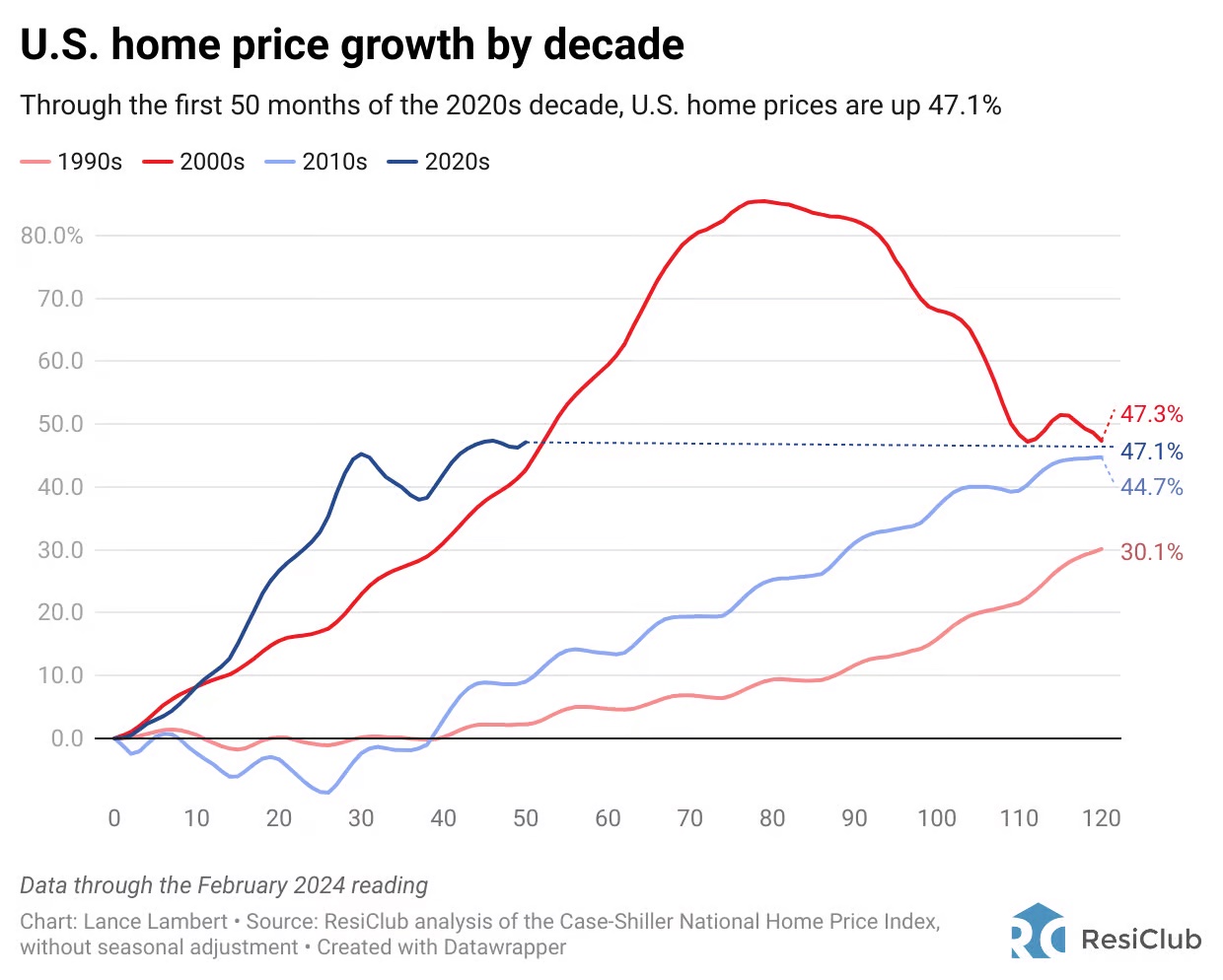
- 1990s Decade: Experienced a 30.1% increase in home price growth.
- 2000s Decade: Saw a 47.3% increase.
- 2010s Decade: Witnessed a 44.7% increase.
- 2020s Decade: Already at a 47.1% increase within the first 50 months.
In summary, the 2020s market has, thus far, been an outlier, displaying higher overall price inflation compared to similar points in previous decades. Nevertheless, long-term home price appreciation is anticipated to continue.
What Does This Mean for You?
The historical data suggests several key takeaways:
-
Long-term Investment: The consistent upward trend across decades underscores the value of real estate as a long-term investment. Even periods of correction are typically followed by recovery and growth, reinforcing the asset's stability.
-
Housing Market Dynamics: Buyers and sellers must remain informed about local market conditions, as national trends can mask regional variations. Some markets are currently experiencing an increase in housing inventory, while others remain at record lows.
-
Future Outlook: With no significant signs of a downturn in the market, strategic investments can still yield substantial returns. However, as with any significant purchase, careful analysis remains essential.
Interested in current data for the Houston market or your neighborhood? Connect with us here.
Final Thoughts
While the current market may seem daunting, history suggests that real estate remains a strong long-term investment. However, given that national trends can mask regional variations, it is crucial to stay informed about your local market. Understanding local dynamics, including prime locations, market data, and up-and-coming neighborhoods, is key to leveraging the potential of real estate for long-term gains.
Categories
Recent Posts